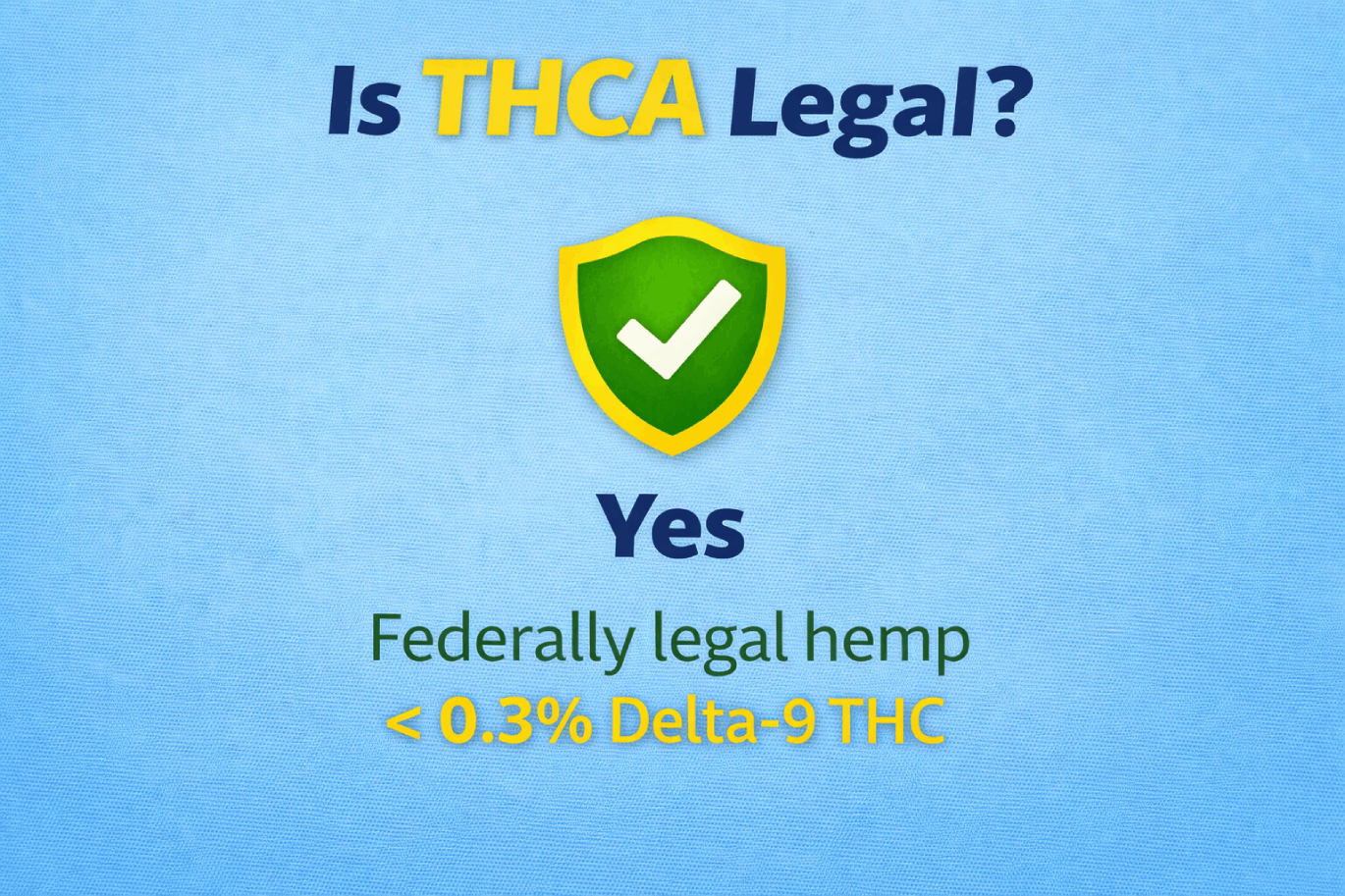
If you are wondering, “Is THC legal”? Then you are not alone. The panorama of legality of cannabis is not simple in the US market, especially in circumstances where it keeps swinging with chemical terms like THCA and Delta 9 THC. So, in short, it is a ‘Yes’, but with certain restrictions.
In this guide, we will break down the state-wise legal status of THCA in the United States and will further explain how chemically and legally it differs from THC, so that you can easily navigate through the various product categories to reach your desired product in no time. But before sharing the tips to purchase with confidence, let’s dive deeper into the legality of THC in the United States.
Tetrahydrocannabinolic acid, or THCa, is a non-psychoactive cannabinoid found in raw cannabis plants in their natural state unless heat further transforms it into psychoactive THC. So THCA is non-psychoactive in its natural raw form, while THC is psychoactive and is associated with the known effects of cannabis consumption. This unique non-psychoactive capability of THCA makes it popular for individuals who want to reap the benefits of cannabinoids without grappling with their intoxicating effects.
From the lens of the law, both hemp and marijuana are part of the cannabis family. The only aspect that differentiates these two categories from a single cannabis family is their varied THC levels.
Delta-9 THC is another name that usually pops up with these two molecules. Speaking the language of chemistry, THCa and Delta-9 THC are nearly identical molecules with only one structural difference. THCa is loaded with an extra carboxylic acid group attached to its molecule. This addition prevents this compound from binding effectively with CB1 receptors in the brain.
On the other hand, Delta-9 THC lacks that extra acidic group. Once it is removed, the molecule promptly starts interacting with the body’s endocannabinoid system. Result? These interaction produces the well- known euphoric effects resulting from cannabis usage. From a legal standpoint, this microscopic difference is the reason for the raised eyebrows.
When THCa encounters heat through any mode of consumption process, a chemical reaction known as decarboxylation occurs. This process removes the acid group from THCa and converts it into Delta-9 THC. This reaction happens so quickly that a lighter flame or temperature of the vaporizer can also complete the transformation within the blink of an eye.
This decarboxylation mechanism sits at the center of ongoing regulatory debates because hemp products may remain legal before heating but potentially violate THC limits afterward. Consequently, regulators increasingly evaluate whether total potential THC levels should determine legality rather than Delta-9 concentration alone.
Is THCa Legal in the United States According to Federal Laws?
As the chemical reactions of these molecules are astonishing, the policies and laws related to these molecules also piqued the interest of buyers, including consumers. The simple question in their mind lies in the legality of THCA across the nation.
This is where things get complicated. The federal government allows cannabinoids derived from legally grown hemp. That includes CBD and potentially THCa when extracted from compliant hemp plants.
However, regulators continue debating whether THCa should be counted toward “total THC” or not. If lawmakers redefine hemp using total THC calculations, many existing hemp products could then suddenly become illegal. For the businesses surveying Is THCA Legal, the answer currently depends on interpretation rather than a single universal rule.
The Agricultural Improvement Act of 2018 completely redefined hemp under U.S. federal law. In the farm bill, Congress declared that hemp is essentially a cannabis containing no more than 0.3 percent Delta-9 THC on a dry-weight basis. Anything above this threshold will be legally qualified as marijuana.
This definition changed the perceptions of many stakeholders, as the existing law was focused only on Delta-9 THC levels and not on total THC potential from THCa conversion. Converting it into simpler terms, hemp plants rich in THCa may technically remain compliant if their Delta-9 THC levels stay below the federal limit at the time of testing.
The Farm Bill further legalized the interstate transport of hemp products. This means that compliant hemp crops and their extracts may legally cross state lines. But, enforcements are still complicated when cannabinoid products move through states with stricter hemp rules.
This is why Shipping documentation matters the most in these cases. Businesses transporting hemp products must carry laboratory reports and compliance documentation to qualify their product as hemp under federal law.
Federal law sets the foundation stone, and state governments further control the details. Some states interpret hemp rules strictly according to federal definitions, while others have expanded their testing requirements to close perceived loopholes.
Several states simply adhere to the Farm Bill 2018 rules. For this, they double-check their legality based on Delta-9 THC concentration alone. If the product contains less than 0.3 percent Delta-9 THC, regulators consider it hemp.
In these states, hemp flower with elevated THCa levels technically remains legal as testing currently focuses only on Delta-9 THC.
While many rely on THC testing, other states imply a different approach. Instead of measuring Delta-9 THC alone, these jurisdictions calculate total potential THC. The formula converts THCa into its potential Delta-9 THC equivalent after decarboxylation.
If their total calculations exceed the legal threshold, regulators instantly classify that product as marijuana instead of hemp. This approach significantly restricts THCa-rich hemp products.
Some jurisdictions have enacted legislation specifically restricting intoxicating hemp derivatives that mimic the effects of regulated cannabis products. State lawmakers frequently justify these restrictions by arguing that intoxicating hemp products bypass regulated marijuana markets and consumer safety standards.
Enforcement approaches vary widely, creating a patchwork of hemp regulations across the United States cannabis industry. For operators navigating this landscape, compliance requires continuous monitoring of legislative updates and enforcement policies.
If you are eager to check the legality of your cannabis products within your state, then you do not want to skip this table
| State | 2026 Legality Status |
| Alabama | Restricted / Gray area |
| Alaska | Legal with restrictions |
| Arizona | Legal |
| Arkansas | Restricted |
| California | Restricted |
| Colorado | Restricted |
| Connecticut | Restricted |
| Delaware | Restricted |
| Florida | Legal |
| Georgia | Legal |
| Hawaii | Legal |
| Idaho | Illegal |
| Illinois | Legal |
| Indiana | Legal |
| Iowa | Restricted |
| Kansas | Illegal |
| Kentucky | Legal |
| Louisiana | Restricted |
| Maine | Legal |
| Maryland | Restricted |
| Massachusetts | Restricted |
| Michigan | Legal |
| Minnesota | Restricted |
| Mississippi | Restricted |
| Missouri | Legal |
| Montana | Legal |
| Nebraska | Legal |
| Nevada | Legal |
| New Hampshire | Legal |
| New Jersey | Restricted |
| New Mexico | Legal |
| New York | Restricted |
| North Carolina | Legal |
| North Dakota | Restricted |
| Ohio | Legal |
| Oklahoma | Restricted |
| Oregon | Restricted / Banned for high-THCa hemp |
| Pennsylvania | Legal |
| Rhode Island | Restricted |
| South Carolina | Legal |
| South Dakota | Illegal |
| Tennessee | Restricted |
| Texas | Legal |
| Utah | Restricted |
| Vermont | Restricted |
| Virginia | Restricted |
| Washington | Restricted |
| West Virginia | Legal |
| Wisconsin | Legal |
| Wyoming | Legal |
Key takeaway:
Some states have decided to entirely skip this scientific debate and have banned intoxicating hemp derivatives straight away. Lawmakers in these jurisdictions argue that intoxicating hemp products are bypassing regulated cannabis markets and are undermining the regulations related to consumer safety.
The aftermath is a patchwork legal scenario where hemp products may be fully legal in one state yet fully restricted in another, completely depending on the state laws.
Some jurisdictions enforce stricter interpretations of hemp law, which has created additional compliance challenges.
In the current picture, many states calculate total THC instead of measuring Delta-9 THC alone. These jurisdictions strictly evaluate whether a THCa could convert into psychoactive THC when heated. If the total potential THC exceeds the legal thresholds, regulators label that product as marijuana.
States in which has total THC enforcement are
A few states enforce extremely strict THC rules that effectively restrict many hemp cannabinoid products. These jurisdictions maintain near-zero-tolerance approaches toward THC content.
The states are
Certain states update hemp regulations frequently as lawmakers attempt to address emerging cannabinoid markets. Businesses operating in these states should monitor legislative developments closely.
States often revising hemp laws include
Before stocking up their inventories, consumers should approach hemp products with the same precautions that are used in regulated cannabis markets. These are
Laboratory reports confirm cannabinoid concentrations, safety testing results, and compliance with hemp regulations. Consumers should always review these documents before purchasing hemp products.
Cannabis and hemp laws vary widely across the United States. A product legally sold in one state may violate regulations in another.
Transporting hemp products across state lines requires caution. Travelers should carry packaging and laboratory documentation demonstrating compliance with federal hemp definitions.
Operators in the hemp industry face unique compliance responsibilities.
Online retailers must evaluate state shipping restrictions and product classification rules. Physical retail stores must verify customer age and maintain compliance documentation.
Interstate transport of hemp products remains federally legal if the products originate from compliant hemp crops.
Responsible businesses maintain detailed compliance systems, including:
In one sentence, yes, cannabis is legal in the US. But the elaborated answer for the legality of THCA remains complex due to the present strict federal laws backed up by numerous state regulations. For businesses that are evaluating ‘is THC legal in 2026’, its compliance requires careful monitoring of legal updates, along with inspecting reliable supply chains.
TerpSourced supports operators by sourcing compliant hemp-derived products that help cannabis businesses to easily navigate the rapidly evolving regulatory landscape across the United States.
Editor’s Note: The information provided on this site is intended solely for general knowledge and should not be interpreted as legal advice or a comprehensive review of current laws. We do not guarantee the accuracy or dependability of the legal details shared here, nor is it designed to influence decisions regarding our products. Laws differ across states and are subject to frequent updates, which means the content may not always reflect the most current legal standards. To ensure compliance, we encourage consulting a qualified attorney in your area or the location where you plan to ship products.
Cannabis labels today often list both THCA and THC, leaving...
Most people buying ‘THCA flower’ don’t realize they’re essentially buying...
Step into the conversation around and THCA feels completely different....