If you order Grape Gas from ten different suppliers, you’ll probably receive ten different strains. There’s hardly any other name that gets used more in the world of gas cultivars than Grape Gas. From a verified Compound Genetics creation to strains that have nothing whatsoever to do with Grape Gas other than sharing an identical aroma, there’s plenty to uncover about this one.
Grape Gas is a cannabis strain hybrid, also known as the nickname for Grape Gasoline, developed by Compound Genetics through breeding the Grape Pie strain from Cannarado with Jet Fuel Gelato.
As a hemp variety, the Grape Gas weed strain crops up on THCa flower listings carrying between 21% and 34% THCa, advertised as exotic or private reserve material on the strength of its purpleness and trichome abundance. Most of it moves as bulk THCA flower rather than retail jars.
The problem with Grape Gas is that the name isn’t owned by anyone. Many breeders, nurseries, and hemp growers have launched their own strains, all of them called Grape Gas, yet having genetics with only the taste in common. That is why it’s crucial for the commercial success of a product to know exactly which Grape Gas you’re dealing with.
This is the written strain history, as produced by Compound Genetics through Grape Pie crossed with their own Jet Fuel Gelato. Described by the breeder as a “grape lollipop covered in kerosene,” this is one of the most apt pieces of marketing copy you will come across.
Tracing backward, there is a clear explanation for the fuel component. Grape Pie is Cherry Pie crossed with Grape Stomper by Cannarado Genetics, containing the grape and berry flavors. Jet Fuel Gelato is Gelato 45 crossed with High Octane and Jet Fuel G6, a line bred for its highly pungent solvent character. One parent supplies the fruit while the other gives the fuel notes.
According to breeder notes, the crossing was done by Chris Lynch, founder of Compound Genetics, in 2017, though he moved on in 2022. It is the same Grape Gasoline lineage that bred Pink Certz, Mellowz, El Chivo, and Gastro Pop, which is why so many modern hybrid strains in the gas-and-dessert category trace back here.
Seven different lineages are known to exist for plants sold as Grape Gas. None of the sellers below is incorrect about their own plant; they just refer to different plants.
| Lineage claimed | What it means |
| Grape Pie × Jet Fuel Gelato | The canonical cross, and the one most listings intend |
| (OG Chem × Granddaddy Purple) × The Truth | Unrelated genetics, widely copied across strain databases |
| Purple Halitosis × The One | A separate numbered cultivar, usually sold as Grape Gas #7 |
| Cherry Pie × Grape Stomper | This is Grape Pie’s own lineage, one generation off |
| Grape Pie × Donny Burger | A cut specific to one grower |
| Gelatti × Grape Gasoline | A child of Grape Gas was sold under the parents’ name |
| Grape Ape × Gas Mask | Unrelated |
Before you buy in bulk, ask the supplier three questions:
Grape Gas is a hybrid, and there’s been no agreement among strain databases on whether it leans one way or the other. Some say it sits right in the middle. Others claim it’s indica dominant. Still others refuse to take sides altogether. No one ever gives a source for their percentage because there isn’t one.
The discrepancy is not as bad as it sounds, however, since neither classification has much validity. In a 2021 study published in Nature Plants, researchers genotyped 137 samples and found the indica and sativa classifications genetically indistinguishable. Anyone asking whether the Grape Gas strain is indica or sativa is asking a question the plant itself doesn’t answer, which is the same conclusion we reached when writing up SFV OG.
A more useful description comes in three parts:
Those three tell a budtender far more about how a jar will perform than a number split ever will.
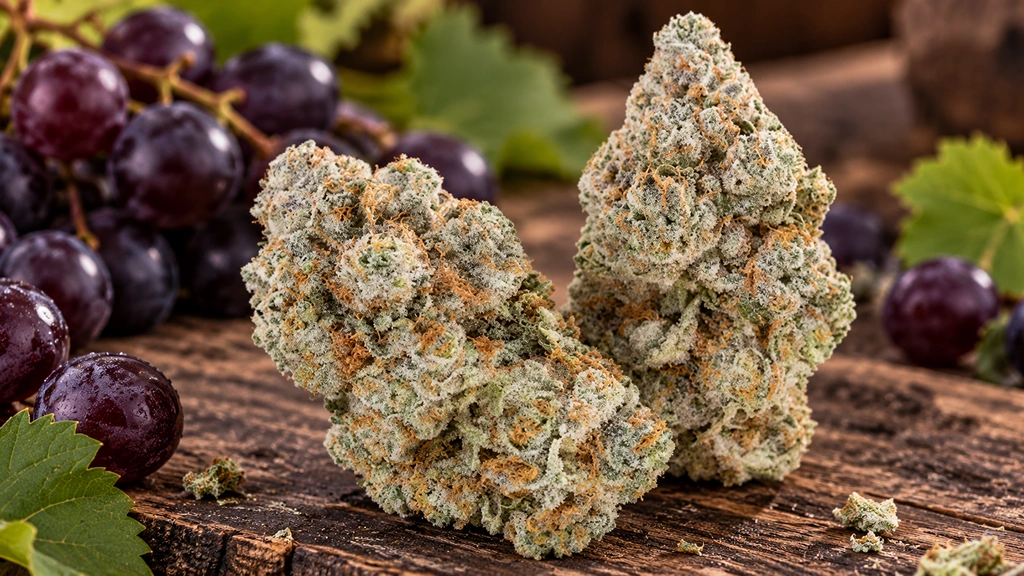
The nose arrives in two parts. Break open a jar and the first element to land is sweet dark grape, more like candy or cola than fresh fruit, with hints of berry and slightly sour citrus. Below it sits the solvent aroma: kerosene, diesel, definitely more workshop than kitchen. Notes of earth and black pepper follow behind both.
On the exhale, the order tends to reverse. Fuel gets carried by the smoke while the grape dissolves, which is why reviewers find the taste heavier and less sweet than the smell advertised. Some batches throw a cheese-like funk or a dry red wine note.
Knowing about that two-part structure matters for retail staff because it is what sells the jar, and it needs to be said out loud. Customers who open a jar expecting grape candy and get diesel will read it as a flaw rather than the intended character. A citrus-forward cultivar like Sour Tangie makes a useful contrast at the counter.
Almost certainly not because of its terpenes. Virtually all strain pages list either myrcene or caryophyllene as the reason behind that fuel smell, but a paper released in ACS Omega in 2021 says otherwise. The cause appears to be a group of volatile sulfur compounds appearing in very low quantities.
The study ran thirteen cultivars through two-dimensional gas chromatography and found one compound, 3-methyl-2-butene-1-thiol, to be the closest match for the pungent odor. This molecule is the one responsible for the off-taste in light-struck beer, and it belongs to a class of compounds similar to those in garlic. Adding it back to a blend of major aromatic compounds reproduced the distinctive smell. A follow-up released in 2023, covering thirty-one extracts, confirmed poor correlation between terpenes and exotic aromas, with sulfur compounds, indole, and esters responsible instead.
Two points are worth considering, though. The research was conducted by a private flavoring company holding relevant patents, and no study exists with sulfur data for Grape Gas specifically. The same compounds carry through into THCA concentrates, which is partly why live resin reads so much louder than cured flower.
Myrcene and caryophyllene appear in almost all Grape Gas samples. The third compound varies, with linalool taking third position in some lab tests and limonene in others.
One published lab panel gives real numbers:
This translates to about 1.3% total terpene content. In flower, values above 1% are good, and values over 2% are genuinely potent.
The smell of each compound has been known for some time. Myrcene is earthy and musky, caryophyllene peppery, linalool floral, limonene citrus. The effects, however, remain unsettled. According to 2020 research in Frontiers in Pharmacology, none of the usual terpenes affect THC activity at the cannabinoid receptors. A nut-and-herb profile like Peanut Butter Breath shows how differently the same few terpenes can present.
Across more than a hundred published user reviews, the pattern is a bright, talkative onset that settles into body weight after twenty minutes or so. The most commonly reported Grape Gas strain effects break down like this.
What people report feeling
Commonly reported downsides
How much weight to give those numbers
Format matters here, too. The same cultivar loaded into THCA disposables tends to read sharper and shorter than flower, because the onset is faster and the dose per pull is smaller. The safe line for a menu or a counter conversation: describe what users report, and stop short of medical claims.
Commercial Grape Gas flower appears between 21% and 34% THCa, with most legitimate samples falling in the mid-to-high twenties. The headline number on the jar is rarely the number that matters.
THCa does not become psychoactive until heat converts it into delta-9 THC, which means a loss of mass in the process. Total THC is obtained by adding delta-9 THC and 0.877 times THCa. Run the published panel above through it: 369.27 mg/g THCa × 0.877, plus 19.25 mg/g delta-9, equals about 343 mg/g, or 34.3% total THC. A COA that lists THCa without running this calculation is only doing half the job.
High values deserve some skepticism. A 2023 PLOS ONE study of flower samples from Colorado dispensaries found that measured THC averaged 23% lower than the lowest labeled value. The same caution applies wherever you are sourcing THCA flower.
The Grape Mint Gas strain is a child of Grape Gas, not another name for it. Dispensary listings put the cross as The Menthol × Grape Gasoline, which places Grape Gas on one side of the pedigree.
| Grape Gas | Grape Mint Gas | |
| Lineage | Grape Pie × Jet Fuel Gelato | The Menthol × Grape Gasoline |
| Relationship | The parent | A child of Grape Gas |
| Top note | Sweet dark grape | Grape with a cool, minty lift |
| Base note | Kerosene and diesel | The same fuel base, a little lighter |
| Dominant terpenes | Myrcene, caryophyllene | Myrcene, caryophyllene |
| Typical THCa on listings | Roughly 21-34% | Low twenties |
| Also sold as | Grape Gasoline | Pink Certz, the same cross |
The Menthol gives that herbal kick; whatever lies below is undeniably Grape Gas. Compound sells the identical cross as Pink Certz, so Grape Mint Gas is most likely a selected phenotype. Don’t mistake either for Grape Mint or Gas Mint, which are completely different plants. Our wider strain catalog lists the gas-leaning cultivars side by side.
Aroma is the first element to go in Grape Gas, and it goes faster than most people realize. The sulfur molecules responsible for the fuel smell reach their peak towards the end of flowering and then decline sharply within about ten days of storage. A jar that smelled harsh at the farm can show up bland.
Terpenes follow a similar but slower pattern. According to an academic study from 1996, one week of storage in paper resulted in the loss of 31% of volatile oils, while one month led to 45%. Monoterpenes such as myrcene and limonene evaporate faster than sesquiterpenes such as caryophyllene, which leaves the aged flower more peppery and less fruity than it was at harvest. The same decay drives the format question we covered in flower vs pre-rolls.
Freshness isn’t a marketing word here; it’s the product.
Breeder descriptions refer to a compact, indica-like plant flowering in about 63 days, or seven to nine weeks. It stretches intensely, up to three times its pre-flower height, so growers usually top or train it early and set light height with that in mind. It tolerates heavy feeding through the third week of flower before needing to be eased off.
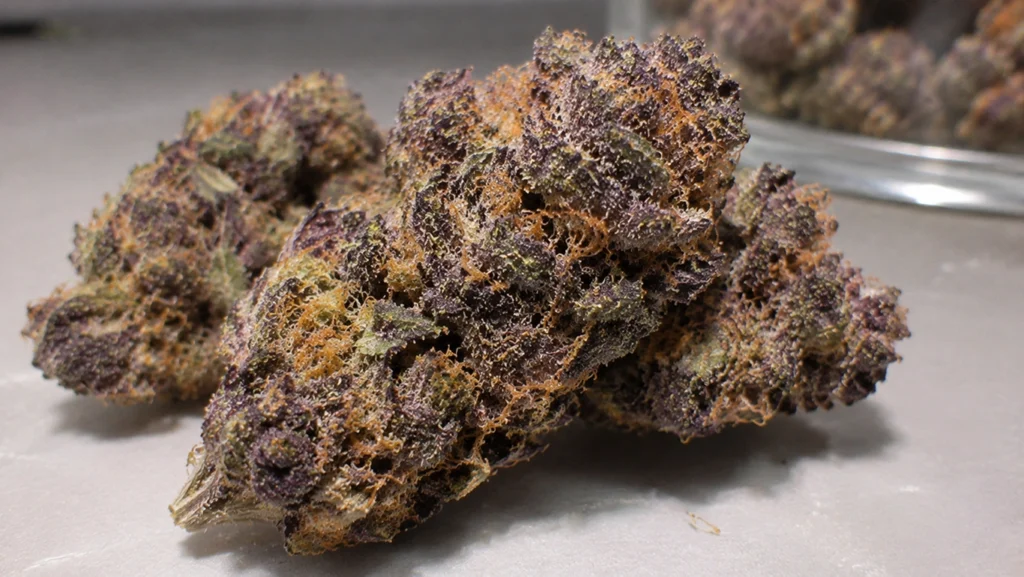
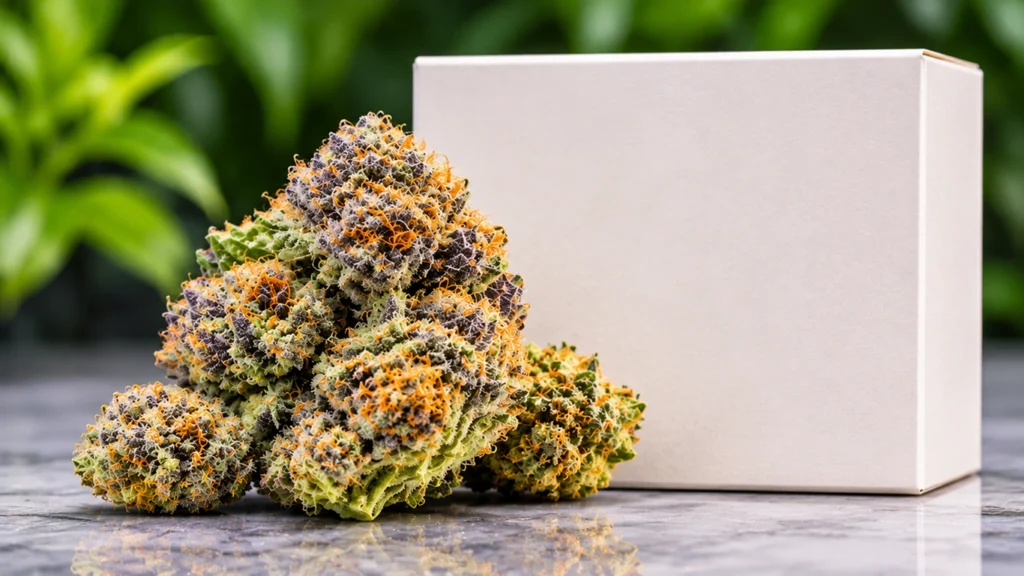
The buds come in dense and round, usually deep purple on cool nights, with large frosty calyxes. Color here depends on the environment, so a Grape Gas that comes in green is not necessarily a lesser one. Resin is abundant, and the line gets used for hash and live resin as often as for flower.
There is an autoflower version crossed with Honey Badger, finishing in 72 to 82 days. Don’t trust the yield data in seed listings, as the same numbers appear verbatim on every site selling them. Growth habit varies far more across sativa strains than within a single gas line.
Rules governing THCa hemp are in transition. The definition of hemp set out in Section 781 of P.L. 119-37 now counts total THC, including THCa, and that definition takes effect for naturally occurring cannabinoids on 11 December 2026. A few states moved first: California AB 8 has restricted inhalable hemp since 1 January 2026, while Texas adopted a total-THC limit on 31 March 2026.
This section was updated on 27 October 2026 and does not provide legal advice. Check your own state’s position with a qualified attorney, and see our compliance FAQ for how documentation travels with each order.
Grape Gas builds its name on a nose that pulls off the remarkable feat of carrying both sweet grape and fuel without either side canceling the other. It’s most famous as a Compound Genetics cross of Grape Pie and Jet Fuel Gelato, although the name itself has a life all its own now.
And that’s the takeaway. The strain name tells you what someone chose to call a plant. The COA tells you what the plant is, the nose tells you how it was handled, and the breeder or cut tells you what to expect when you order again. Learn to read all three and strain names, stop feeling like a roll of the dice.
Look for origins, check the total THC math, and buy fresh. TerpSourced keeps COAs tied to the exact batch in the box, with flexible minimums for shops testing a new cultivar.
Usually, yes. Grape Gas is the common shorthand for Compound Genetics’ Grape Gasoline, and the two terms are used interchangeably. However, several unrelated cultivars are also marketed under the Grape Gas name, so confirm the cut before you commit.
Grape Pie × Jet Fuel Gelato is the recognized parentage. The fruit comes from Grape Pie, bred by Cannarado Genetics, and the solvent note from Jet Fuel Gelato. Other sellers list entirely different parents under the same name, which is why origin matters before purchase.
It’s a hybrid, and sources disagree on which side it leans. More useful is that it’s THCa-dominant with a myrcene and caryophyllene terpene profile. The indica-sativa split has repeatedly been shown not to reflect a plant’s actual chemistry.
Research points to volatile sulfur compounds present in traces, especially 3-methyl-2-butene-1-thiol, rather than terpenes. The same group of compounds causes flavor defects in light-struck beer. Terpenes give the fruit and spice notes, but the gas seems to come from somewhere else.
Commercially available samples vary between 21% and 34% THCa, with reliable products in the mid-to-high twenties. THCa should not be confused with total THC; multiply it by 0.877 and add the delta-9 figure to get the number that matters.
Myrcene and caryophyllene sit in first and second position, with either linalool or limonene third, depending on the cut and the grower. In one published panel, the total came to 1.3%, decent but not outstanding for the flower.
No. The Grape Mint Gas strain is a cross of Grape Gas and The Menthol, carrying a cool, herbaceous note that its parent lacks. Compound Genetics markets the same cross as Pink Certz, so treat them as the same genetics under two names.
Users most often report relaxation, euphoria, and happiness, with dry mouth the most frequent side effect. These are self-reported rather than medical findings. Effects also differ between batches, since several genetic lines are marketed under this one name.
Breeder notes put it at about 63 days, or seven to nine weeks of flowering. Plants can stretch to three times their pre-flower height, so most growers train early. The autoflower version is ready to harvest in roughly 72 to 82 days.
Search the Grease Monkey strain, and you get flavor notes,...
Figures below come from our own COAs and order records...
For most strains, the name comes from how they taste....



Sign up for exclusive wholesale offers, new product alerts, bulk pricing updates and more.

No spam. Unsubscribe anytime. ❤️